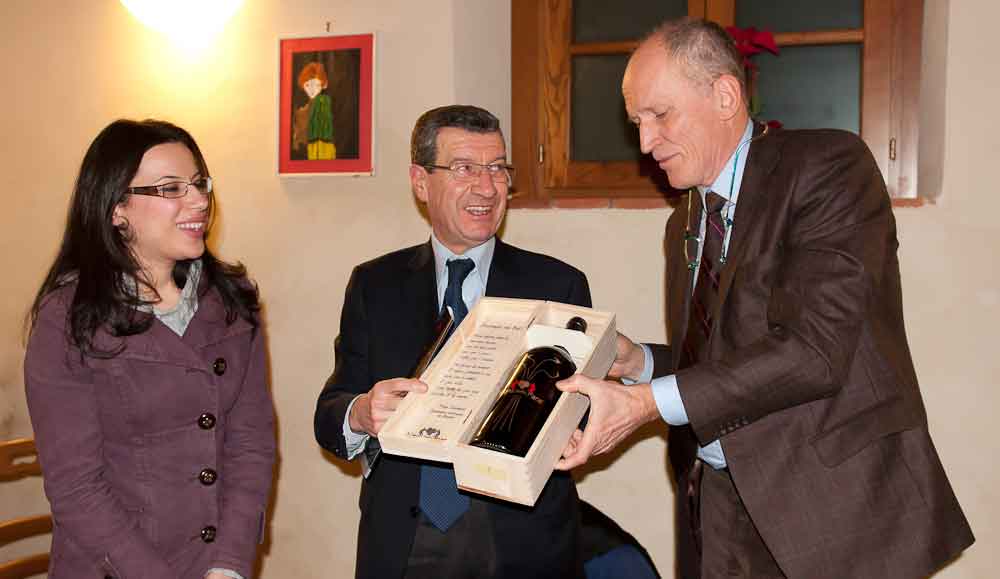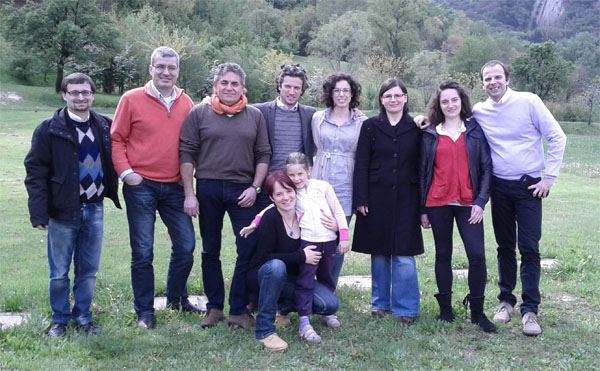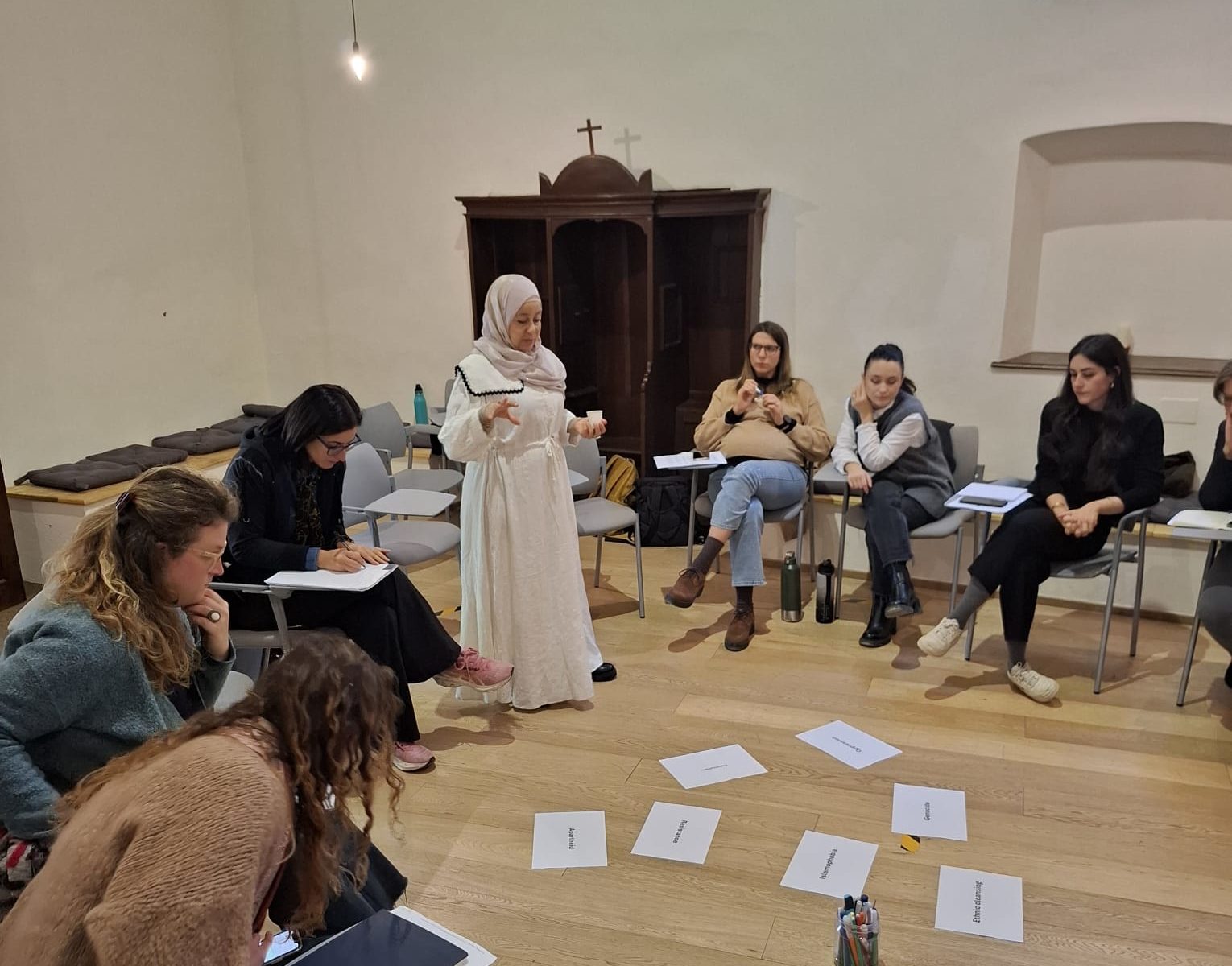
In Rondine, one of the Italian stages of the international project promoted by Caritas Italiana: young people from 19 countries learning peace as a common good.
Training for peace is possible. This is the conviction behind PeaceMed, the international project promoted by Caritas Italiana, co-funded by the Ministry of Foreign Affairs and International Cooperation and carried out in collaboration, among others, with Rondine Cittadella della Pace. It is a shared commitment aimed at strengthening the skills of civil society operators and young leaders from countries bordering the Mediterranean and the Horn of Africa.
In the autumn of 2025, the Autumn School took place in Rome—one of the three planned stages of the twelve-month training program—bringing together representatives of social, educational and religious organizations from 19 countries: Tunisia, Morocco, Egypt, Spain, Malta, Greece, Cyprus, Türkiye, Lebanon, the Holy Land, Syria, Jordan, Iraq, Somalia, Djibouti, Mauritania, with the aim of extending the network also to Algeria, Libya and Iran.
Rondine, a Mediterranean laboratory
Among the most significant moments of the Autumn School was the training day in Arezzo, at Rondine Cittadella della Pace, which welcomed participants for a full immersion in the Rondine Method: an educational approach based on the creative transformation of conflicts, dialogue, and the building of authentic relationships.
In the Tuscan hamlet—where for about thirty years young people from countries involved in armed conflicts have lived and studied together—the PeaceMed participants were able to experience a concrete model of peace education. “In Rondine we understood that peace is not an abstract idea but daily work made of trust, effort, and mutual listening,” said Danilo Feliciangeli, the Italian coordinator of the project.
The encounter represented a symbolic bridge between the young people of the Mediterranean and those of Rondine, united by the same desire to move beyond the logic of the enemy and to build relationships capable of withstanding today’s tensions and divisions.
Building a network of peace
PeaceMed – Promoting peace as a common good was created to strengthen the skills of those who work every day in local communities, refugee camps, educational centers, and third-sector organizations. The goal is twofold: to train peacebuilders capable of managing and transforming conflicts non-violently, and to build a permanent network of cooperation and dialogue among the shores of the Mediterranean.
Rondine and the challenge of dialogue
During the training, participants met the young fellows of Rondine coming from conflict-affected countries. Their direct testimonies made tangible the possibility of overcoming the enemy mindset and discovering, in the other person, not an adversary but an opportunity for growth.
“Through our collaboration with Rondine, we felt the strength of those who have already experienced conflict transformation,” Feliciangeli emphasized. “Their stories show us that it is possible to build a different reality, even when the world seems to surrender to the resignation to war.”
This journey echoed in the words of Pope Leo XIV, who during the Angelus of November 3 publicly greeted the PeaceMed participants: “I greet the representatives of the PeaceMed group, coming from various Mediterranean countries.” A gesture of attention that gave new strength and visibility to the project.
Voices of Hope
In the video made during the Autumn School — available on YouTube — the faces, words and emotions of the protagonists unfold. Men and women who work in their own countries to build peace, each starting from their own context. Rondine’s contribution to PeaceMed embodies the essence of its mission: to train people capable of generating trust, remaining humane within conflicts, and bringing back new ways of living together to their communities.
Because, as Franco Vaccari, founder and president of Rondine, recalls: “Every young person who comes here brings with them a piece of conflict and transforms it into a seed of dialogue. This is how peace stops being a utopia and becomes a craft, a skill, a daily choice.”
More at: www.caritas.it