Rondine’s delegation took part in MED 26, the initiative promoted by the Archdioceses of Marseille and Barcelona to strengthen dialogue among Churches, peoples and civil society across the Mediterranean. At its core was the educational responsibility to build peace, foster cooperation and restore relationships
Rondine once again took part in the Mediterranean Meetings, promoted by the Archdioceses of Marseille and Barcelona. The gathering brought together participants from thirty countries, fifty bishops and eighty civil-society organisations.
The process was launched several years ago at the initiative of the Italian Bishops’ Conference and Cardinal Gualtiero Bassetti. MED 26 follows the path opened by previous meetings held in Mediterranean cities including Bari in 2020, Florence in 2022 and Marseille in 2023, with the aim of strengthening dialogue among the Churches and peoples of the Mediterranean while promoting peace, cooperation and mutual understanding.
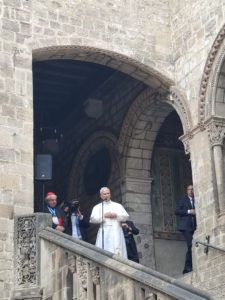
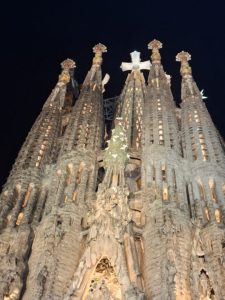
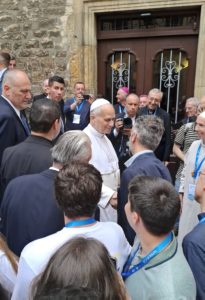
A particularly significant moment for Rondine’s delegation was its participation in the celebration presided over by Pope Leo XIV for the inauguration of the Tower of Jesus of the Sagrada Família, on the centenary of Antoni Gaudí’s death.
The Pope’s words resonated powerfully before millions of people: “We cannot believe in Jesus and wage war. We cannot believe in Jesus and kill innocents.”
It was a clear and universal call to the responsibility of building peace and repairing relationships, fully aligned with the spirit of the Mediterranean Meetings and with the mission that has always inspired Rondine.
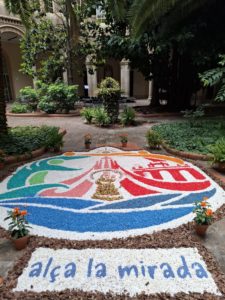
MED 26, held under the title “Alzad / Alça la mirada” – “Lift Up Your Gaze” – gathered bishops, young people, theologians, representatives of ecclesial institutions and civil-society organisations working in the fields of education, solidarity, holy places’ protection, religious communities and reconciliation processes. Once again, the Mediterranean was placed at the centre not merely as a geographical area, but as a living frontier of our time: a place of conflict, migration, historical wounds and inequality, but also of encounter, shared responsibility and the possibility of building peace.
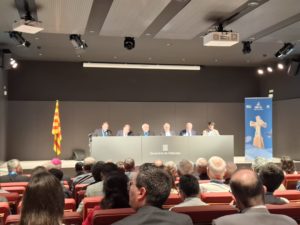
During the working sessions, participants discussed the main social and pastoral challenges facing the different shores of the Mediterranean – North Africa, the Middle East, the Black Sea region, the Balkans and southern Europe – as well as the priorities needed to give continuity to the Mediterranean process launched in recent years. The discussions highlighted the need to listen to communities wounded by conflict, to place young people at the heart of a “Mediterranean consciousness” serving the common good, to strengthen educational networks, to support the younger generations and to turn interreligious and intercultural dialogue into concrete paths towards peace.
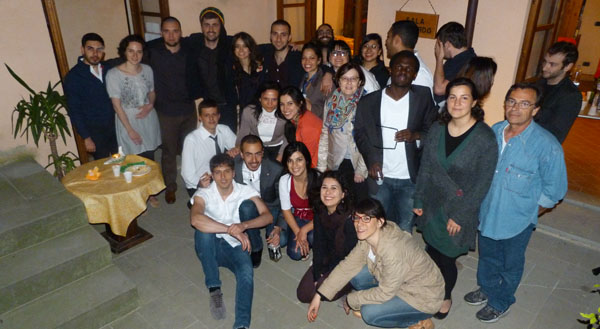
For Rondine Cittadella della Pace, taking part in the Mediterranean Meetings was especially meaningful. For more than twenty-five years, Rondine has worked on the creative transformation of conflict, training young people from countries affected by wars, tensions and identity-based divisions. The Mediterranean meetings in Bari and Florence gave rise to the two editions of the project “Mediterranean, Frontier of Peace”, which brought twenty young professionals to Rondine. After completing their training at the Citadel of Peace, they returned to their countries to implement social and interreligious-dialogue projects together with local partners.
This daily commitment found a shared horizon in Barcelona: a Mediterranean called not to raise walls, but to lift up its gaze.
«MED 26 reminded us that peace is not born from abstract declarations, nor is it built only around diplomatic tables. It grows through educational processes, concrete relationships and communities capable of remaining within complexity. The Mediterranean is today one of the world’s great classrooms: a place where conflicts, migration, inequality and different religious and cultural identities meet. For this reason, peace education must increasingly become a civic, educational and political competence. Rondine brings to this journey the conviction it develops every day, especially within the World House: the enemy can become a person again when someone creates the conditions for an encounter that is possible, protected and generative. Peace cannot be built without relationships, as the young participants in MED 26 also concluded», said Mauro D’Andrea, director of Rondine’s Department of Training and International Relations.
Rondine’s presence in Barcelona was therefore part of a broader path, one in which the Mediterranean was recognised as one of the decisive regions for the future of peace. It is not a border to be crossed only with fear, nor an unstable periphery to be observed from a distance, but a fragile and necessary laboratory where Churches, institutions, young people and civil society are called to share responsibilities, languages and actions.
In the centenary year of Antoni Gaudí’s death, the Sagrada Família became a powerful symbol of this journey: a work that was never truly completed, built over time, generation after generation. Like peace. It is not an immediate result, not a formula to be proclaimed, but a patient architecture of relationships, listening, justice and forgiveness.
The Mediterranean Meetings concluded with a commitment to continue the process opened in previous stages, turning the Barcelona discussions into shared orientations and new lines of work. For Rondine, this means continuing to invest in education as the place where peace stops being merely an idea and becomes concrete experience, a possible relationship and daily responsibility.
To lift up one’s gaze today means recognising that the Mediterranean does not need words of peace alone, but communities capable of generating it. Rondine brought this conviction to Barcelona: every conflict can become a threshold, if people are educated to cross it together.